
The 2026 World Cup kicks off tomorrow.
104 games. Three host countries. Venues spread across the map.
I wanted all of it in my calendar. Every match. The star players. The odds. A favorite for each game.
Doing that by hand is an entire evening. Nobody actually does it.
So I gave an AI one sentence, walked away to make coffee, and came back to a finished calendar.
Here is exactly what happened.
This is not a chatbot answering a question
Let me be clear about what you are looking at.
The tool on screen is Claude Cowork running Fable 5, the newest model. Nothing custom. You could run this today.
The prompt is the part with a story.
Yesterday I ran this exact build inside my own system, an AI Marketing Brain powered by GIRO, working through Claude Code. It is the same system I install for clients to run their ad accounts and funnels. GIRO is Spanish for spin. Every time I run it, it gets better. Halfway through the real run, I realized anyone could benefit from this one. So I asked my system to write a portable version of the prompt, one that runs in Claude Cowork with a calendar connected.
That portable prompt is what you see in the video. It is also the exact prompt I hand you further down. The system that engineered it is mine. The tool that runs it is yours already.
The difference is simple.
A chatbot answers a question.
This runs a project.
It did not do one task. It spun up a team.
The old way: an entire evening nobody has
Think about what this actually takes if a human does it.
Pull all 104 fixtures. Convert every kickoff into one time zone. Find two players to watch for all 48 teams. Get current title odds. Pick a favorite for every group game. Then enter all of it, one event at a time, color-coded by stage.
That is hours of careful, boring work.
That is the work AI is built to crush.
One agent becomes three
Here is what most people miss about real AI agents.
The brain does not do everything itself. It delegates.
One agent became three. Research. Cross-check. Write.
One built the schedule. One pulled the top players for 48 teams. One went after the odds. All running at the same time, all verifying each other against real sources.
A normal chat window cannot run a project like that. This can.
The only thing I typed
I did not give it steps.
I did not walk it through the process.
I stated the outcome and the rules, hit send, and let go. Here is the exact prompt I pasted. I am not gatekeeping it.
You are my autonomous research-and-scheduling agent. Today is June 10, 2026.
Goal: load the COMPLETE 2026 FIFA World Cup into my Google Calendar, and narrate
each step out loud so someone watching understands what you're doing.

WRITE TARGET: my Google Calendar named exactly "World Cup 2026" (NOT my primary).
Put every event there. All kickoff times in US Eastern Time (America/New_York).

STEP 1, RESEARCH (use the web; if you can run parallel sub-agents, split this into
three and say so out loud):
  (a) The full match schedule, all 104 matches: match number, date, kickoff in ET,
      venue, stage (Group A to L, Round of 32, Round of 16, Quarter-final,
      Semi-final, Third place, Final), and the two teams. For knockout matches use
      bracket labels like "Winner Group A" since the teams are not decided yet.
  (b) The 12 groups, and for every one of the 48 teams the TOP 2 players to watch
      (name, position, club).
  (c) Current title odds (top 12 or so favorites), AND for each group-stage match
      which team is the betting favorite (mark genuine even matchups "toss-up").
  Cross-check at least two reputable sources. If a source looks stale or wrong,
  say so and discard it. Flag anything you are unsure about.

STEP 2, WRITE THE CALENDAR (one event per match on "World Cup 2026"):
  - Group game title: "Team A v Team B, Group X (Fav: favorite)"
  - Knockout game title: "Stage, Match N, bracket slot v bracket slot"
  - Notes for each: favorite, venue, ET and local kickoff, and the top 2 players
    for each side on group games.
  - Each event 2 hours long, starting at kickoff ET.
  - COLOR-CODE BY STAGE using Google colorId:
      Group stage = 7 (Peacock)
      Round of 32 = 9 (Blueberry)
      Round of 16 = 3 (Grape)
      Quarter-final = 6 (Tangerine)
      Semi-final = 5 (Banana)
      Third place = 8 (Graphite)
      Final = 11 (Tomato)
  - A few late kickoffs cross midnight into the next ET day. Place those correctly
    and note it.

STEP 3, when done, give me a one-paragraph recap: how many events you created, the
color legend, the title-odds top 5, and anything you flagged as uncertain.

Be efficient, narrate clearly, and do not stop to ask me to confirm. Just build it.
That is it. One sentence of effort. The agent figures out the work.
Two practical notes before you run it. First, connect your Google Calendar: in Claude, go to Settings, then Customize. Connectors lives under Customize now. Connect it, apply it. Second, use Claude Cowork on the newest model, Fable 5. Real talk from my own recording session: the regular chat surface did not finish the build for me. Cowork did. And change the time zone line if you are not on US Eastern.
The part that separates a toy from a system
During the original build inside my system, something happened that is the whole point.
One odds source was stale. It listed teams that had not even qualified.
A chatbot would have repeated that, confidently, and put wrong information into my calendar.
This thing caught it. It flagged the source as wrong, threw it out, and kept only the ones that agreed with each other.
Two sources minimum on every fact.
That is the difference between a toy and a real system. A toy gives you a fast answer. A real system checks its own work before it hands you something.
104 events, written
Research done, it started writing.
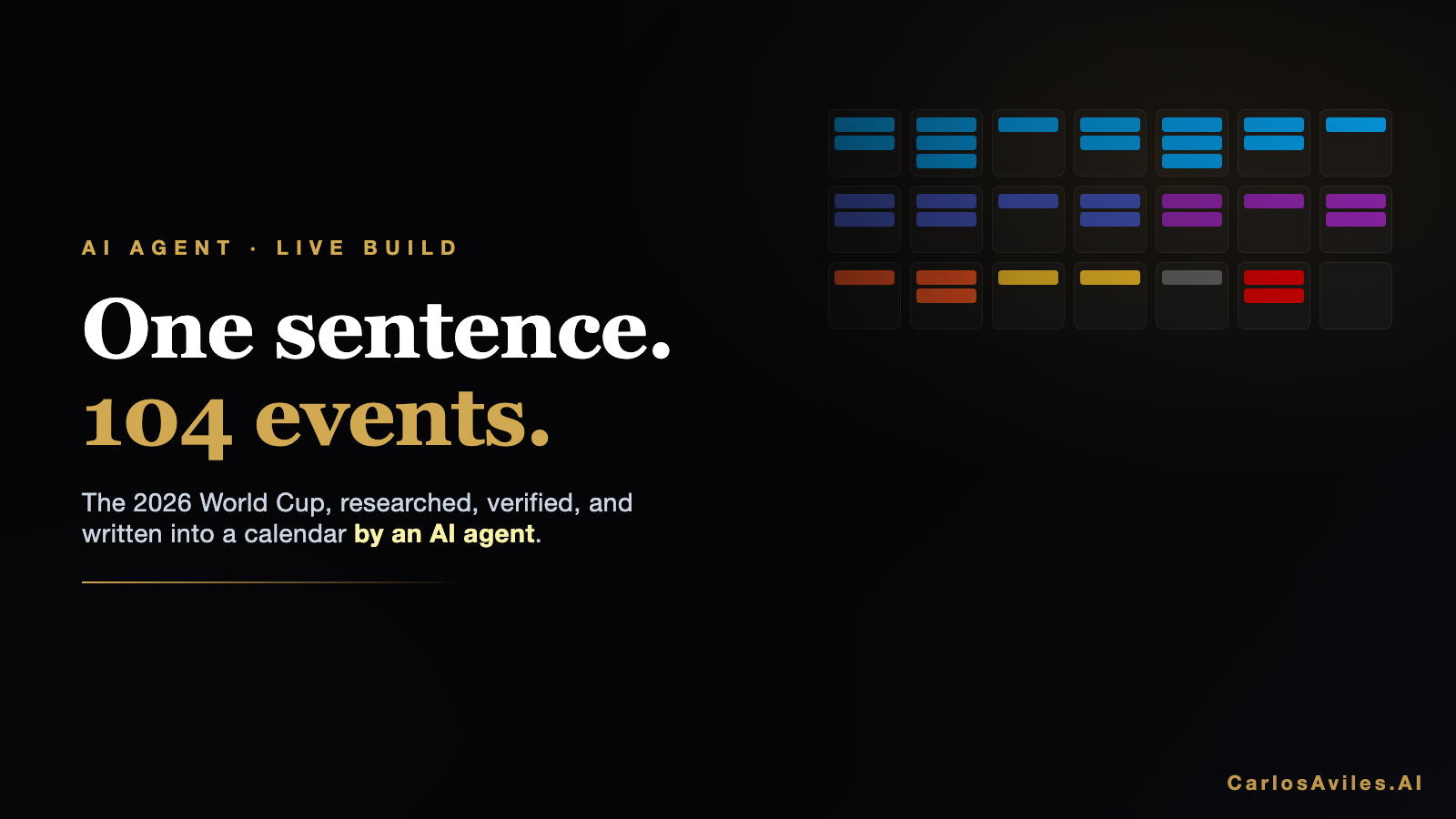
104 calendar events, one after another. The favorite in the title. Two players to watch, the venue, and both kickoff times in the notes. Color-coded by stage so the whole tournament reads at a glance.
Then the payoff. Scroll from the June 11 opener at the Azteca all the way to the July 19 final. Color everywhere.
Open any single game and the detail holds. Mexico v South Africa shows Mexico as the favorite, the top two players to watch for each side, the venue, the odds, both kickoff times. All 104 are built like that.
One sentence of effort from me. The agents did the rest while I made coffee.
Here is the truth: AI did not decide anything
This is the part I need you to sit with.
The AI did not decide anything. It did not pick the goal. I did.
I chose to load the World Cup. I set the rules. I defined what “done” looked like.
All it did was crush the labor between my decision and the finished thing.
That is Fundamental #3 of the five I teach.
AI is an amplifier. You are still the operator.
The person who knows what they want still wins. They just win faster now.
Now swap “World Cup” for “my business”
Soccer is the fun version.
Take that same brain. Take that same fan-out into Research, Cross-check, and Write. Point it at a client’s ad account, their offer, their email list, instead of a calendar.
Same mechanic. Higher stakes.
The agent does not decide the strategy. The operator does. The agent collapses the hours of execution that used to sit between the decision and the result.
That is what I install. The soccer calendar is just what I am allowed to show on camera.
Want to use AI as a real amplifier?
If this hit you, the next step is simple.
I teach the 5 Fundamentals. It is the free framework for using AI as a real amplifier instead of a party trick. Fundamental #3 is the one you just watched in action.
Get the free 5 Fundamentals Checklist here: get.clientswithai.com/opt-in-page
If you would rather start by building a campaign, start with the $27 Campaign Foundation.
Save this if you keep hearing that AI will replace you. It will not. It will replace the hours between your decision and your result.
The person who knows what they want still wins.